

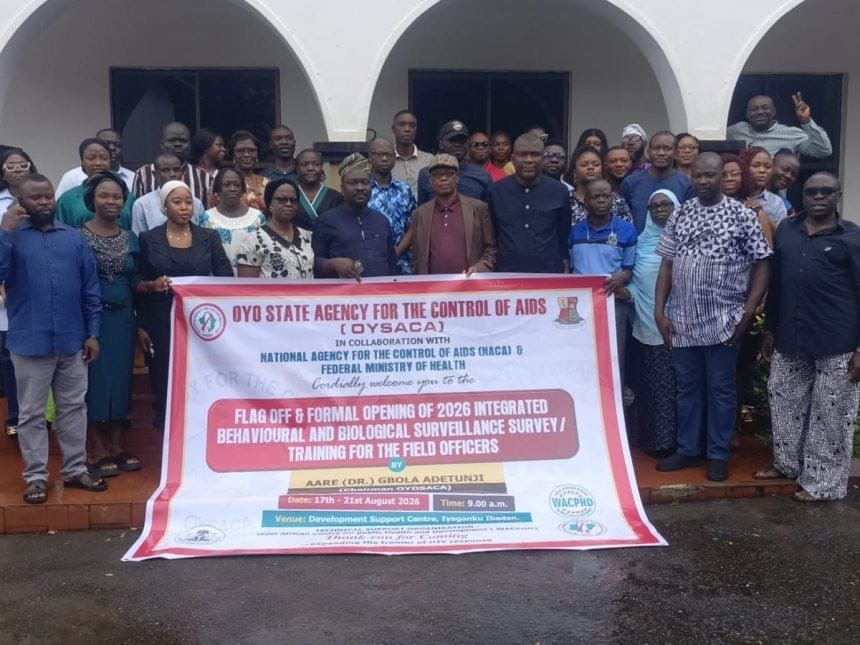
The Oyo State Agency for the Control of AIDS (OYSACA) has flagged off the 2026 Integrated Biological and Behavioural Surveillance Survey (IBBSS), seeking credible data to strengthen HIV prevention, treatment and care in the state.
Speaking at its launch, OYSACA Chairman, Aare (Dr) Gbola Adetunji said the survey would generate biological and behavioural information on key populations, including female sex workers, men who have sex with men and people who inject drugs, to guide more effective HIV interventions.
According to him, the 2026 survey in collaboration with the National Agency for the Control of AIDS (NACA) and the West Africa Centre for Public Health and Development (WACPHD) will provide updated evidence on risk behaviours, access to HIV prevention and care services, HIV status awareness and treatment uptake, as well as HIV prevalence, trends and incidence.
The chairman stressed that the success of the exercise would require collaboration among government, technical teams, development partners, implementing partners and community representatives.
He also called for the protection of participants’ privacy, dignity and rights, urging stakeholders to ensure that the exercise was conducted professionally, ethically and without discrimination or stigma.
Adetunji said the survey should go beyond data collection, noting that its findings must translate into better policies, stronger programmes and improved access to HIV-related services.
He appealed to all stakeholders to support the field teams and ensure that the exercise produces credible and actionable evidence for improving HIV prevention, treatment and control in Oyo State and Nigeria.
The Acting Chief Executive Officer of WACPHD, Chukwebuka Ejekam, explained that the exercise is part of a national survey being conducted simultaneously in 12 states to determine whether HIV interventions implemented since the previous exercise have produced the desired results.
He said findings from the 2020 survey showed a high HIV burden among some key populations, citing a prevalence of 15.5 per cent among female sex workers and an increase from 3.4 per cent to 10.9 per cent among people who inject drugs between 2014 and 2020.
Ejekam disclosed that about 40 field personnel had been recruited and were being trained for the Oyo exercise, comprising 31 researchers for the behavioural component and nine personnel for laboratory, counselling and biological activities.
According to him, fieldwork will follow hotspot validation and is expected to run through September and October, after which analysis and report writing will commence.
The OYSACA Management Information and Evaluation lead, Taofeek Taiwo Abdulwahab, said the survey would combine HIV testing with behavioural assessments covering issues such as prevention knowledge, condom use and attitudes towards people living with HIV.
He said the exercise would provide the data needed to plan interventions aimed at reducing HIV prevalence in Oyo State and Nigeria.
The Oyo State project coordinator, Ayodeji Aduloju, appealed to members of the targeted communities to cooperate with field workers and provide accurate information.
Aduloju assured participants that information obtained during the exercise would be kept confidential, stressing that their cooperation was essential to producing reliable evidence and reducing HIV prevalence among key populations before 2030.





Leave a Reply